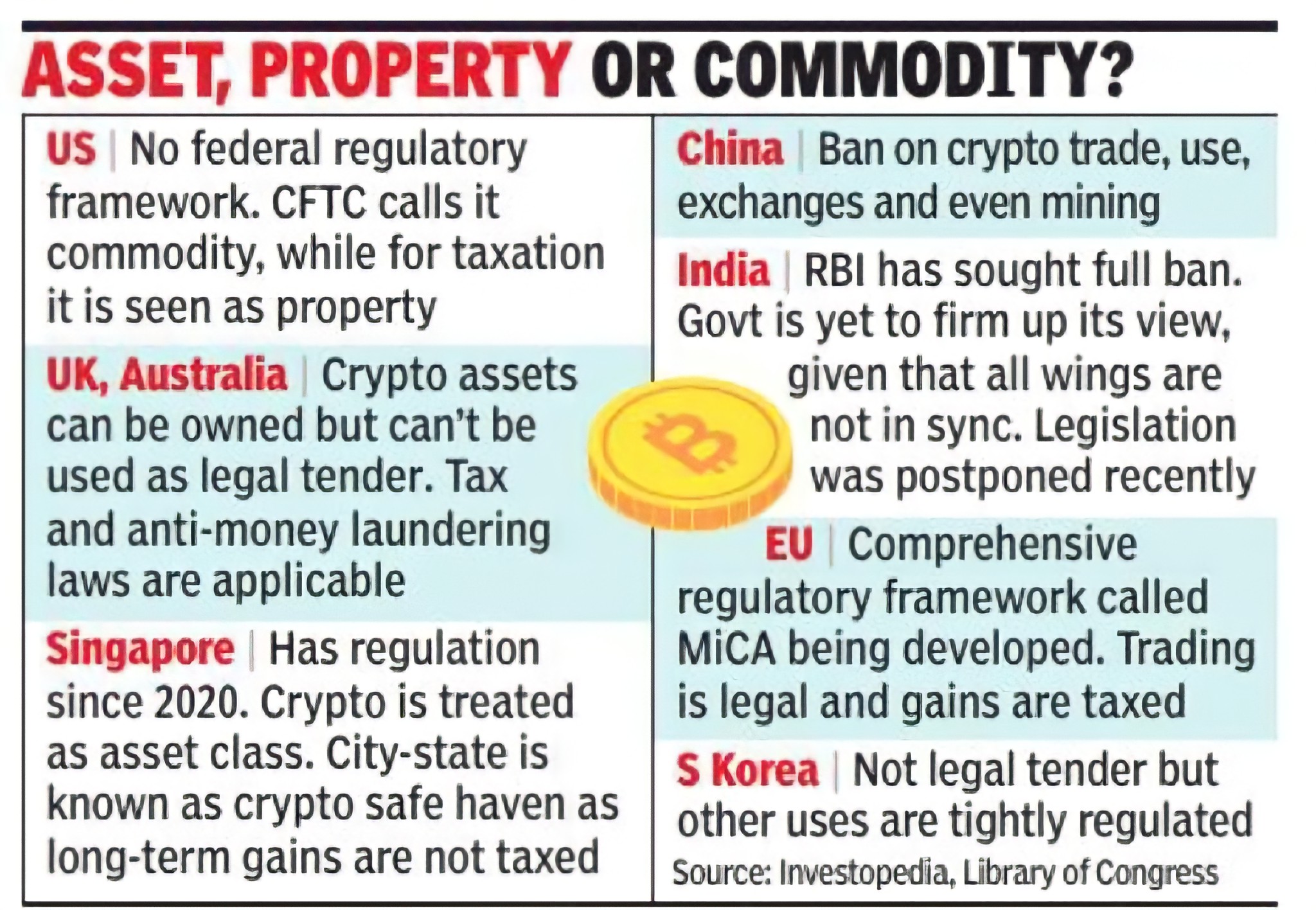




Crypto classification dilemma: Is it an asset, property, or commodity? Regulators across the globe have come up with various definitions of cryptocurrencies. But there is no consensus, even among major economies, on how to treat decentralised virtual currencies, which are seen posing a risk to financial stability and impacting crossborder transactions. Policy advisers and legal experts say most countries are
unable to formulate a policy on virtual currencies as there are no precedents apart from bans, which have been largely ineffective. Crypto’s growing popularity has caught lawmakers’ attention as it could undermine state oversight over monetary policy, capital flows, and illicit activity if left unchecked.
While only one country — El Salvador — has recognised bitcoin as legal tender, nine others, including China, have completely banned crypto. Forty-two countries like Bangladesh have banned it ‘implicitly’, which means banks areprohibited from dealing in crypto directly or indirectly and crypto exchanges are barred too, according to a Law Library of (US) Congress report published in November last year.
“Lack of consensus on crypto regulation is mainly due to the ambiguity on whether to treat crypto as a ‘currency’ or an ‘asset’. Most people are using it as a speculative investment,” said Probal Bhaduri, managing partner at Lumiere Law Partners. He added that lawmakers are also having difficulties in understanding the technical aspects of crypto.
“Classifying crypto as commodity can tackle market and compliance risks, but not illicit activities, financial stability,systemic and capital flight risks,” said a report by Policy 4. 0, a think tank founded by blockchain expert Tanvi Ratna.
In the US, some states view crypto favourably, but there is no federal regulation. For taxation, crypto has been classified as ‘property’ since 2014. Derivatives regulator CFTC has said crypto is a ‘commodity’, while markets watchdog SEC has not made any definitive statements on treatment of crypto.
The Indian government is yet to firm up its view, given that all wings are not in sync on the issue — something that led to the introduction of the proposed legislation being postponed until at least the next Parliament session. The RBI has called for a complete ban on crypto as it said partial restrictions won’t work. Sebi chief Ajay Tyagi has asked mutual fund companies not to invest in cryptorelated assets until the government comes out with a policy.
The Policy 4. 0 report said that “making laws on paper and expecting full compliance is infeasible for a technology that makes it easy to bypass controls”. The report cited examples of South Korea and China, where tough regulation and ban, respectively, have not been fully effective.
“As enforcement of bans is both difficult and impractical, countries should look to establish robust regulatory frameworks on crypto and educate investors on the risk,” said Nitin Sharma, principal associate at Lumiere Law Partners. According to him, low investor maturity & susceptibility to fraud and concerns related to terror financing & money laundering will be among key factors while dealing with crypto.
Organisations like IMF and WEF have noted that though crypto can help make crossborder payments efficient and improve financial inclusion, its operational and systemic risks means that regulation needs to be on the global agenda.