



Cryptocurrencies, like stocks, can be bought instantly using an app. But there are major differences between the two assets in the investment process. How is crypto buy different from an equity investment? What happens once you place an order for crypto or stocks? How does a crypto exchange source the asset and manage liquidity risks? Where is your Bitcoin or Ethereum finally stored? How have centralised exchanges grown despite crypto’s push for decentralisation? Aseem Gujar & Partha Sinha find out…
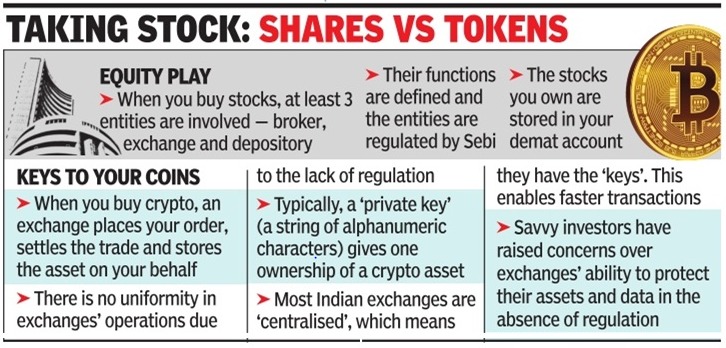
When you click to buy stocks, the broking company, where you have opened a demat account, places an order on your behalf on the BSE or the NSE. The exchanges then find a match and relay transaction details to the depositories CDSL or NSDL. These depositories process the actual transfer of shares to your demat account in two business days.
Once you tap to buy crypto, the exchange, where you have an account, will find a match for you in the market, take delivery of the asset from the seller and then store it on your behalf. To invest in virtual currencies, you need to open an account with a crypto exchange, provide KYC details and load rupees in the platform’s bank account to trade on the bourse using that balance. Cashing out is also an instant process. Unlike stock exchanges, crypto bourses play the role of an exchange, a depository, and a broker. Another key difference is crypto exchanges are unregulated entities.
NO UNIFORMITY AMONG EXCHANGES
Many crypto exchanges have come up in India to cater to the demand for these risky assets amid the pandemic induced low interest rate environment. However, these exchanges don’t have a uniform method to source crypto or manage liquidity risks.
Bhagaban Behera, CEO and co-founder of social crypto exchange Defy, said that for each order, there is an attempt to find a buyer/seller within the same platform. Otherwise, exchanges source crypto from larger bourses or buy from institutions.
Behera said that they keep the crypto purchased by the user in an insured wallet, but some exchanges give the custody of assets to the buyer. Mridul Gupta, COO of crypto exchange CoinDCX, said investors’ assets are stored on the exchange’s wallet. And user funds can only be moved from these wallets after
authorisation.
WHO KEEPS ‘PRIVATE KEYS’?
“Not your keys, not your crypto” is a saying popular among crypto backers referring to custody of the tokens. Typically, possession of a ‘private key’ (alphanumeric characters) gives one ownership of a crypto asset. However, in India, most exchanges are ‘centralised’, which means they hold these ‘keys’ on behalf of the investor. While this may go against crypto’s concep t of removing the middleman, industry players said this is done due to convenience as ‘custodial wallets’ enable faster transactions. Also, not all investors want to take res ponsibility for keeping the ‘keys’ safe as ‘misplacing’ them would mean losing access to their assets.
Regulated entities have obligations in handling financial assets. But since there is no governance framework in India on how crypto exchanges should function, their operations are determined by their business models, said a legal researcher, who didn’t wish to be named. The absence of regulation means there is no uniformity in terms of trade settlement, liquidity management and customer security measures.
Sathvik Vishwanath, co-founder and CEO of crypto bourse Unocoin, said that his customers can either take custody of their assets or keep them with the platform.
HACKING, DATA PROTECTION CONCERNS
Savvy investors said they prefer to keep custody of their assets due to data protection concerns and because centralised exchanges are susceptible to theft and hacking.
“Centralised exchanges are easy-to-use for non-tech people. But overdependence on it may deprive people of crypto’s fundamentals. Crypto enables the user to be their own bank. But whether the end-user is willing to take that responsibility is up to him,” said a moderator of Reddit forum CryptoIndia, which recently hosted a Q&A session with Unocoin’s Vishwanath.
New regulation could mandate that all trading of crypto must be conducted only through licensed exchanges that comply with KYC and other requirements, said Shilpa Mankar Ahluwalia, partner & head (fintech) at Shardul Amarchand Mangaldas.
Gaurav Mehta, founder of Catax, a crypto tax and audit platform, said, “Postregulation, exchanges will have to give precedence to price discovery , risk management, and compliance over injecting artificial liquidity or offering their own coin. ”