



Aseem Gujar & Partha Sinha TNN
Mumbai:
On Christmas Eve in 2013, the RBI had issued a note cautioning Indians about financial, legal and security risks of cryptocurrency. It came four years after the world’s first cryptocurrency, bitcoin, was launched.
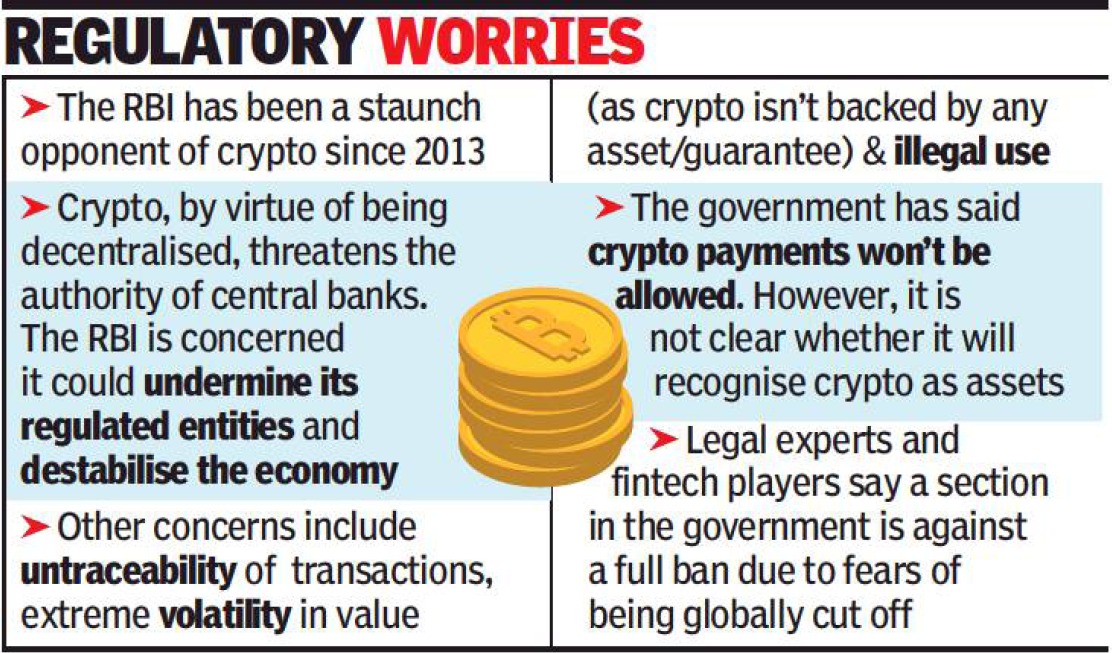
Eight years later, the central bank’s opposition to crypto has only become stronger. Earlier this month, the RBI told its board that a ‘complete ban’ on crypto was needed as partial restrictions won’t work. In 2018, the RBI had effectively banned crypto trade in India as it ordered banks not to facilitate it. A Supreme Court ruling in 2020, however, set aside the central bank’s order.
The RBI has consistently resisted crypto as it has concerns related to financial stability. The central bank’s monetary policy would be less effective if crypto is allowed to move freely. Virtual currencies would also undermine banks and other regulated entities. Other concerns about crypto include extreme price volatility and difficulty in tracing transactions.
Besides, in a country like India, managing the foreign exchange risk will be a greater challenge given that money would flow in via digital currency and not necessarily in the form of dollars, RBI sources have argued. Even IMF chief economist Gita Gopinath highlighted this challenge while pointing out that emerging and developing countries face a greater threat.
The view from Mumbai’s Mint Road is that crypto should neither be treated as a currency nor an asset, especially given the concerns over illegally channelling funds.
The government is yet to firm up its view given that all wings are not in sync on the issue — something that led to the introduction of the proposed legislation being postponed until at least the next Parliament session.
According to a fintech player, a section in the government may be against a full ban due to fears of being cut off globally and being clubbed with China, which banned crypto this year.
Legal experts say that, while recognising crypto as legal tender is out of the question, it is too late to ban crypto. According to them, the government’s approach will have to be balanced so as not to hurt investors but at the same time not let it grow uncontrollably as that could threaten the country’s foreign exchange reserves and lead to disruptions in the economy.
“The government is viewing cryptocurrencies as investment instruments and plans to regulate them. Under income tax rules, cryptocurrencies are likely to be treated as assets and attract capital gains. GST and TDS are other areas where the position of law is not clear,” said L Badri Narayanan, executive partner, Lakshmikumaran & Sridharan Attorneys.
“You cannot take money out of India without permission. We are a foreign exchange-regulated market and that means we cannot take certain decisions like developed countries that have a free market,” said Narayan. He added that it would be tough for regulators to stop crypto payments by Indians abroad.
The crypto industry too has sought clarity on foreign exchange and tax laws. “Under FEMA (Foreign Exchange Management Act), the cross-border movement of ‘goods’ and ‘services’ is classified as import/export. However, the regulations do not clarify whether crypto tokens amount to ‘goods’,” said Sumit Gupta, CEO & cofounder of CoinDCX, a crypto exchange, and co-chair of industry body BACC.